
hassan hajjaj, between heritage and hybridity
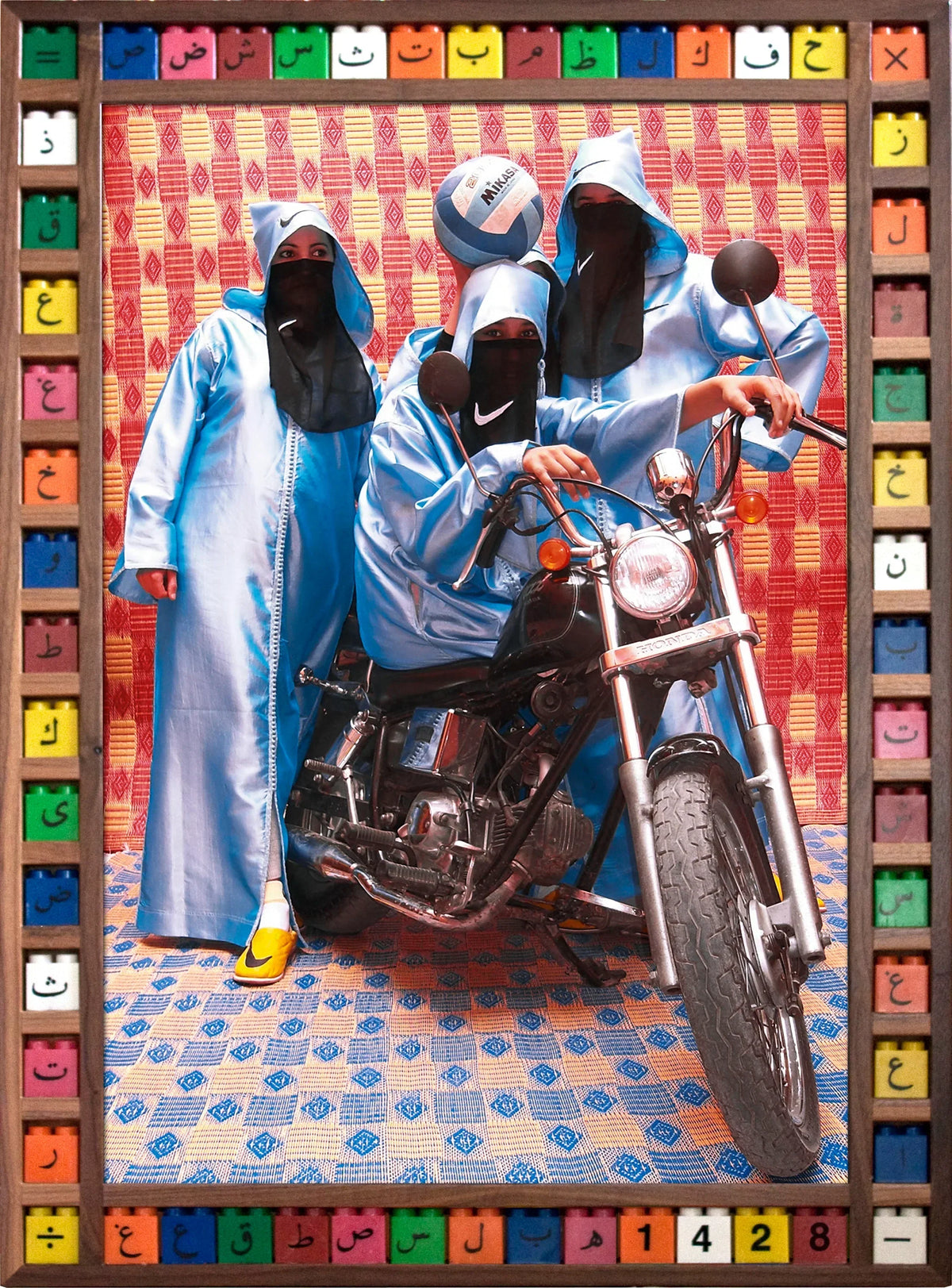
The Moroccan “Andy Wahlou” turns an alleyway into a studio and a tea tin into a picture frame. Based in London, this pioneer of Moroccan pop art celebrates cultural hybridity, photographing Nicki Minaj, Billie Eilish and Madonna alongside his own neighbours and local shopkeepers — with the same meticulous protocol: props, fabrics, zellige patterns.
The studio everywhere, the everyday as frame
That boldly assumed style, those hyper-saturated images, are also found in the work of multidisciplinary artist Hassan Hajjaj. Nicknamed “Andy Wahlou” by his friend Rachid Taha, he is today considered the pioneer of Moroccan pop art. In his hands, a simple alleyway can become an improvised photo studio, decorated with North African textiles and everyday materials.
His aesthetic work does not stop at photography: Hajjaj's signature extends to his original frames, made from everyday objects. That is how Nicki Minaj ends up posing on two storage pallets, against a red fabric backdrop scattered with white stars, framed by Moroccan tea tins. Footballers, musicians, singers — all pass through, often with a nod to his roots.

Identity as a process
While the artist remains deeply attached to his roots, he also carries a profoundly multicultural identity, having moved to London very young into a thriving artistic environment. The two cultures he grew up in have shaped his work extensively, and are the very source of a duality found throughout it. That is the whole meaning of his portraits, where a single model may wear a traditional veil alongside designer sunglasses or a football shirt. In his work, these two worlds coexist naturally and invite the viewer to step back from their own preconceptions. On this point, the writer Michket Krifa says of Hajjaj, quite rightly, that he celebrates hybridity and sees identity as a process in constant evolution, moving beyond geographical oppositions, between the traditional and the modern. The repetition of everyday materials echoes traditional Moroccan zellige mosaics while drawing on pop art aesthetics.

Music is also very important to me, and I listen to it while I work. That's why, I think, the images and the frames have a kind of rhythm.
Hassan Hajjaj — Afrique XXI
My Rock Stars, a body of work in music
The exhibition My Rock Stars tells the story of Hassan Hajjaj's career through a musical body of work. And for good reason: music occupies an essential place in his practice, both as a discipline in itself and through the figures who embody it. Billie Eilish, Madonna, Rachid Taha, Lee Scratch Perry, Alicia Keys & Swizz Beatz, the gnawa m'alem Boubker Gania… his “Rock Stars” are singular, spanning every style, in the image of his art. For each of them, Hajjaj devised a genuine protocol: glasses, socks, hats, accessories, and clothes made to measure by his own hand.

The exhibition is accompanied by an original sound piece from Acid Arab, pioneers of oriental electro in France, designed to extend the energy of the show. Blending ancestral rhythms, techno pulses, punk energy, disco and rap, it celebrates the musical heritages of North Africa and the Middle East.
Hassan Hajjaj, My Rock Stars
Musée de la Musique
22 September 2026 to 25 April 2027
Full price €12 · Concession €10 · Concession 2: €6
commentaires (0)
Aucun commentaire pour l'instant — lance la conversation.