
kerry james marshall, restoring the black body to art history
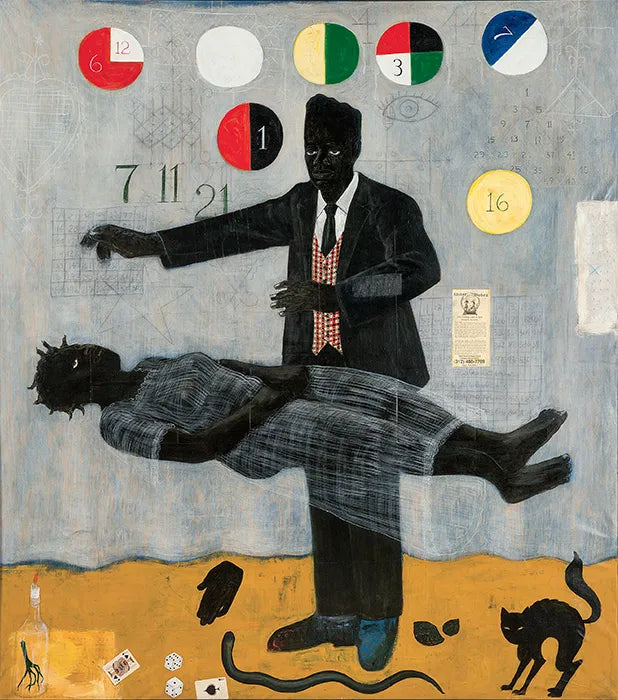
American artist Kerry James Marshall has been painting Black bodies since the 1980s, using pigments such as iron oxide to heighten their darkness. Between pop, Afrofuturism and the classical tradition, his painting writes them back into the grand narrative of art history, from which they had long been excluded.
Violence rendered through colour
Born in Alabama in 1955, Kerry James Marshall was marked from a very young age by the African-American emancipation movements he witnessed first-hand. That violence he transcribes into his work, taking on subjects such as the forced crossing of enslaved Africans, or the legacy of Black American mobilisations — without ever depicting violence or alienation head-on. Beyond the image, it is through colour itself that he carries this message, heightening the darkness of skin with pigments such as iron oxide, allowing him to magnify “Black beauty”.
People ask me why my figures have to be so black. There are a lot of reasons. First, blackness is a rhetorical device. When we talk about ourselves as a people and as a culture, we talk about black history, black culture, black music. That's the rhetorical position we occupy. Somebody has to start representing that blackness in the extreme and letting it be beautiful.
Kerry James Marshall — The New York Review of Books, 23 July 2020
That rhetorical position is anything but incidental in the artist's work. Driven by a concern for representation within global art history, he has devoted his life to occupying as much institutional space as possible, in order to assert the presence of Black bodies, female and male alike, on equal footing with the white bodies that alone inhabited it for centuries.

A history painter who refuses a single style
While the artist says he has “always wanted to be a history painter on a grand scale, like Giotto or Géricault”, he differs from them sharply, refusing to confine himself to a single style as most of his peers do. His strength lies precisely in that diversity of techniques and references, all mastered with equal ease: nineteenth-century French painting, contemporary culture, Afrofuturism, comics, science fiction. It is this singularity that allows him to inscribe his Black figures beyond any one movement, sending them travelling and placing them back at the heart of a far wider art history — the one from which they had until now been excluded. A method not unlike Henry Taylor's ongoing retrospective at the Musée Picasso. There, the artist offers a masterful reinterpretation of Les Demoiselles d'Avignon, titled From Congo to the Capital, and Back Again. That gesture performs, in its own way, the same work of reappropriation: taking a founding milestone of Western art history and writing back into it, this time, Black bodies long held at a distance from the canon.

This is the whole point of the exhibition, and one of the many reasons it is worth the trip. It does not merely show paintings; it forces you to look differently. Faced with these canvases, our eye — shaped by centuries of an almost exclusively white art history — is confronted with its own blind spots. Going to see this exhibition means accepting to challenge your gaze, to shift it, to train it to finally observe what it had not learned to see. Above all, it means taking part in a much broader act of repair, giving their rightful place back to bodies that art history rendered invisible for far too long, pushed to the margins, or simply erased. What Kerry James Marshall offers is not a new movement. It is a reintegration into the grand narrative of painting.
Kerry James Marshall, The Histories
Musée d'Art Moderne de Paris
18 September 2026 to 24 January 2027
Full price €17 · Concession €15 · Free under 18
commentaires (0)
Aucun commentaire pour l'instant — lance la conversation.