
building a community around repair: levi’s makes its bet
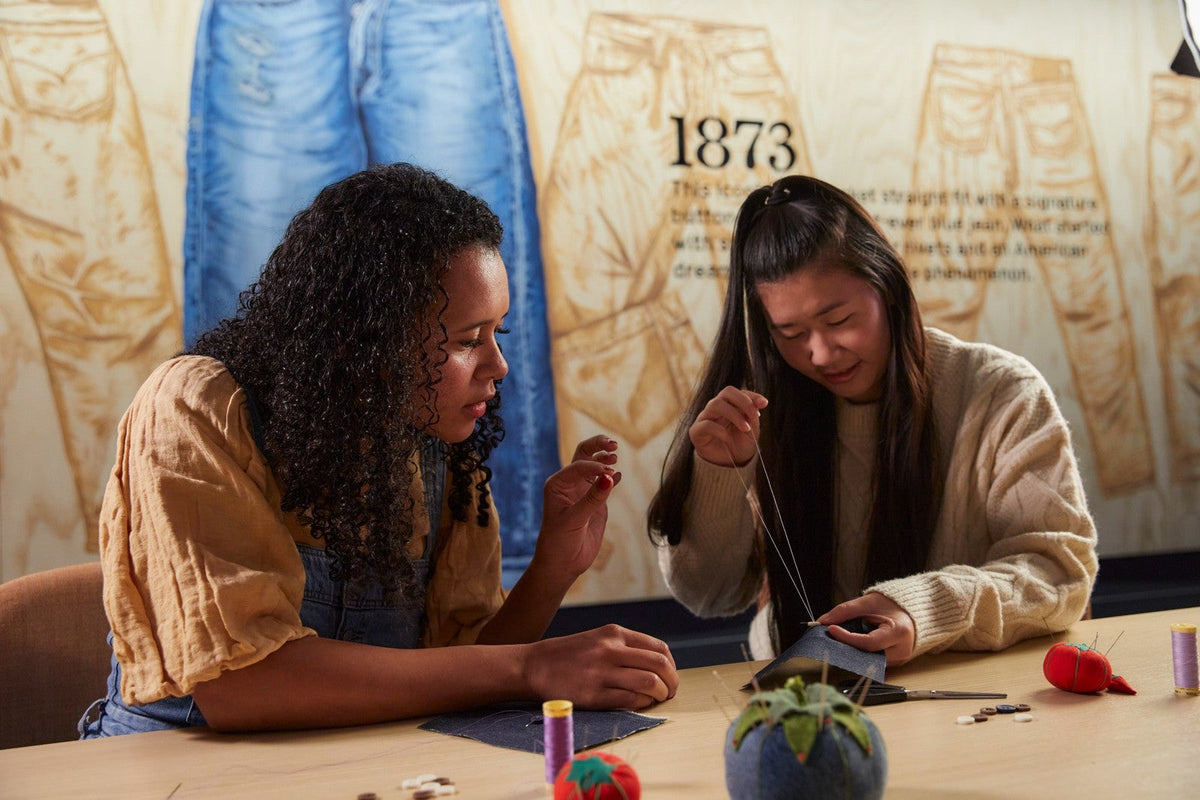
Introducing young people to the afterlife of clothing: that is the promise championed by denim specialist Levi’s.
A fashion item follows a life cycle of its own. After several washes and countless wears, it is no longer quite the same, not necessarily worse, just different. Buttons slip away, cuts widen, stains invite themselves in: so many changes that alter the garment.
Because throwing things away should never be the answer, salvaging emerges as the option of choice. And Levi’s has chosen to position itself on exactly that ground. Earlier this year, the brand launched its brand-new programme, Levi's® Wear Longer Project, whose ambition “is to equip the next generation with the practical skills to care for and customise the clothes they already own.”

Levi's® Wear Longer Project expands to London and Paris
After a first stage in the United States, Europe naturally emerged as the next market to win over, and London and Paris in particular, creative cities where the initiative seems to make complete sense.
“The Wear Longer project quickly gained momentum in the United States, reaching more than 90,000 young people and giving us solid results on which to extend the programme to new markets. Europe was the logical next step: we chose London and Paris as our first pilot markets because of the enthusiasm for our brand within those communities and their vibrant creative ecosystems,” says Alexis Bechtol, Director of Community Affairs at Levi Strauss & Co.
A future rollout across the rest of France
France also has a long tradition of craftsmanship, creativity and personal expression, which makes the idea of repair and customisation particularly relevant. We want to meet young people where they are and pass on practical skills they can make their own, whether in a Levi’s store, at school, through a local association or via our network of employees.
Paris marks the beginning of our work in France. Alongside the launch of the Wear Longer project, we are also widening access to professional repair services through our partnership with United Repair Center. Those services will be available in selected Levi’s stores in Paris, and we plan to extend them to other French cities by the end of the year.
The expansion also follows a study carried out by Levi’s in Europe showing that Generation Z (1997-2012) “is more interested in clothing repair than older generations.” There is a paradox, however, because while almost half of the respondents in that age group (43%) say they are interested, those same people admit they know little about the subject.
“The study shows clearly that young people want to acquire this knowledge and that they value it. Our heritage and our expertise put us in an ideal position to support them in that learning,” argues Paul Dillinger, VP of Design Innovation at Levi Strauss & Co.
Giving young people accessible, playful tools
Aware of how central education is to learning, Levi’s offers free digital teaching resources through the Discovery Education platform. Designed for teachers and young people alike, they give access to in-depth content as well as hands-on video tutorials that provide ready-made keys to repair and customisation.
Theory is matched by practice, with workshops that Levi’s runs alongside its long-standing partner United Repair Center (URC), which brings its expertise “to the hands-on learning experiences offered in both cities.”

For Alexis Bechtol, “education is an essential part of the Wear Longer project, because access to repair starts with the confidence and the skills to take it on yourself. Our partnership with Discovery Education allows us to bring those skills into classrooms and make them accessible through free digital resources, while hands-on workshops give young people the chance to put them into practice in a real setting.
Our partnership with United Repair Center completes that work. URC brings professional repair expertise and a high social impact model, while we, alongside our community partners, help make repair and customisation more accessible to a wider audience. We work hand in hand with URC to train our employees and our students in London and Paris. Together, these efforts help turn repair into a skill anyone can learn, practise and build into the way they care for their clothes.”
Building a community around clothing repair
Beyond the act of repairing, obviously central to the programme, there is a clear notion of transmission. As Alexis Bechtol explains, Levi’s applies a train-the-trainer model with its employees. “We pass on not only repair skills but also good facilitation practices, so that they can embody the programme in their own communities, teach it in their local schools and with association partners. We are committed to building a network of teachers, employees, store teams and local partners who can keep sharing this know-how over time.”
He stresses the collective dimension of the programme, whose aim is to build a growing network of people who see repair and customisation as know-how that deserves to be passed on. “Through workshops, schools, associations and employee-led programmes, we create opportunities to build these skills collectively and to pass them on to others.”
The students become ambassadors in turn: once they have acquired these practical skills, they can share them with their friends, their families and the people around them, extending the programme’s impact well beyond each workshop. “We see them as participants, but also as creators: when a young person learns to repair or customise a pair of jeans, they build their own relationship with the garment and, by extension, with the brand,” Alexis Bechtol continues.
“It is only natural that the relationship works both ways. We can share the craft, the history and the durability that make Levi’s what it is, while young people bring their creativity and their own take on what these products mean to them. That exchange is essential if our heritage is to stay relevant and keep evolving with the next generation,” he concludes.
comments (0)
No comments yet. Start the conversation.